《鲁镇往事》
2017年8月24日
上海话剧艺术中心呈献
实践空间
华文小剧场节
《鲁镇往事》整场一个半小时的演出,没有冷场。层出不穷的巧思,就如相声里的抖包袱一般,制造出各种效果,让观众乐不可支,笑声连连。这个戏借用鲁迅的几个文本的故事,但演出来的却完全不是鲁迅。鲁迅的小说,往往运用强烈的反讽,产生深沉的知识分子的反躬自省。鲁迅批判得最强烈的不是社会与历史,而是看客与他们的心态,那些冷漠无情,对社会里不幸的人物情事毫无同情心与同理心的反应。社会与历史的问题,是看客造成的。《鲁镇往事》里呈现出来的是另一种反讽,剧场演出把观众都变成了看客,全场一起热烈激情的嘲笑鲁迅批判的人物,同时嘲笑鲁迅怜悯的人物,也其实在嘲笑鲁迅。
这个演出倒是给我们一个反思的机会:剧场效果的目的究竟是什么。剧场面对观众,以观众为主要诉求对象,讲求与观众的互动,这是剧场当下的现实,也是剧场的任务。可是,在剧场里堆叠耍弄各种看起来聪明的效果,刺激观众的反应,就是剧场最终的目的吗?这种态度就像那句陈词滥调“顾客永远是对的”所蕴含的精神,服务提供者要竭尽所能让顾客开心满足。
剧场里所追求的engage观众,并不应该是在这个层次。剧场要问的,不只是观众要什么,还应该问剧场要给观众什么。然后再问,做出来的剧场,是否达到这个目的,观众是否接收到剧场要给他们的东西,剧场是否在观众的感受和思想里产生回荡。剧场效果不是不可以使用,但如果效果是最终目的,那就不如看马戏团、杂耍表演或者综艺节目。
重要的问题,更是剧场导演对待小说作者的态度,以及他的剧场的基本关怀。 最近另外两个改编文学作品的剧场,九年剧场的《画室》改编自英培安的小说,穷剧场的《七种静默:忿怒》改编自黄碧云的小说。他们的改编,是对小说和原作者的尊重,他们的剧场也充满效果,但效果是在于强化小说的内涵。在他们的剧场里,看到原著的精神与思想;剧场的二次创作的新意念,是诚恳谦逊的为原著服务,也是对观众的一种服务。
《鲁镇往事》谢幕时观众热烈鼓掌叫好,走出剧场听到好些观众说戏很好看。我倒是难过起来。这个戏没有让观众理解鲁迅批评看客的精神,反而是制造了更多的看客。
Showing posts with label 实践剧场. Show all posts
Friday, 25 August 2017
Friday, 11 August 2017
《七种静默:忿怒》:对待他者的态度
《七种静默:忿怒》
2017年8月10日
穷剧场呈献
42新剧中心黑箱剧场
实践华文小剧场节
导演/演员高俊耀说:“同情是善举,本源自内在有所感,但高举姿态,同情就成了恶,彰显阶级差异和分别心,将他者从自我推开,‘他们,不是我……’行为景观化,将目光投注在急需良善和美好填充世界的观众。”
玛莉、未夏、九月、垃圾婆、七只手、阿雄仔,住在狭窄龌龊的公屋,看不到明天的底层世界。他们被现实遗忘,在困境中挣扎。这些人物,从作家(小说原作者黄碧云)的笔下与导演的手中被再现出来,会是怎样的一种面貌,会不会有自己的声音?创作者与被再现人物之间,是一道无法逾越的鸿沟,再现出来的往往是戏剧化、浪漫化、煽情化的结果。他们的声音反而被泯灭,他们的故事被同情与消费。
高俊耀的那番话,无疑是创作者自我省视与警觉的自白。剧中的人物,被赋予自己的声音,由他们叙述自己的际遇。他们不需要同情,来自他们世界以外的同情,对他们来说也没有作用。同情只实现在戏剧演出的那个当下,观众离开剧场,情绪恢复之后,一切又变得理所当然。这个戏,不是让观众自我洗涤,而是要观众深切感受人物的困境,带着离开剧场,并一直在脑中心底回荡,犹如阴魂不散的鬼魅。
妓女玛莉和失业汉(嫖客)未夏之间, 究竟是什么关系?只是消费与被消费?长期相处是否有另外一些情愫?把所有人物的故事都说完之后,玛莉问未夏,为什么不开灯。他们都是在黑暗中挣扎看不到光亮的人物。未夏没有直接回答,反问玛莉,你的真实名字是什么。原来他们的关系,一向来是在一种暧昧与掩藏中进行。未夏终于想知道玛莉的真实身份,想认识玛莉这个人。接着未夏趋前与玛莉接吻,象征两人的关系进入交心的境界。这是光明的结局吗?显然不是。未夏接着爬上高楼,一跃而下结束了他的一生,结束了他与玛莉的关系,似乎也结束了他的困境。
稍早时玛莉把少年九月交托给未夏照顾。未夏放火烧屋前,要九月离开,不要再回来。九月离开了,不知去向。他是这些人物的希望吗?他能够摆脱困境吗?他走得出去吗?戏剧的结束,是两个演员高俊耀和郑尹真(他们分别扮演剧中所有的人物),将之前扮演过的所有人物的衣物穿在身上。他们象征剧中出现过的所有在困境中挣扎的人物。一边穿上衣物,一边叙述后来遇见九月的情境。那些被套牢的困境中的人物,看着以为走出去的九月。九月离开没有再回来,观众可能以为九月得以重生。可是,他只不过是从一个困境走出去,进入另一个困境。
观众总是希望结尾有一点光明,心灵能够得到一点抚慰。这样一来心里会比较好受,同时可以施舍一些对他者的同情,可以对他者的困境有一点释然。可是,这不是导演要的结果。结果是观众带着压抑与忿怒离开剧场。也许,这种压抑与忿怒的情绪,还有一点机会在未来的生活中,转换成自我的提醒。如果这种情绪与体验,还能够成为改变现实的动力,那当然会更好。
2017年8月10日
穷剧场呈献
42新剧中心黑箱剧场
实践华文小剧场节
导演/演员高俊耀说:“同情是善举,本源自内在有所感,但高举姿态,同情就成了恶,彰显阶级差异和分别心,将他者从自我推开,‘他们,不是我……’行为景观化,将目光投注在急需良善和美好填充世界的观众。”
玛莉、未夏、九月、垃圾婆、七只手、阿雄仔,住在狭窄龌龊的公屋,看不到明天的底层世界。他们被现实遗忘,在困境中挣扎。这些人物,从作家(小说原作者黄碧云)的笔下与导演的手中被再现出来,会是怎样的一种面貌,会不会有自己的声音?创作者与被再现人物之间,是一道无法逾越的鸿沟,再现出来的往往是戏剧化、浪漫化、煽情化的结果。他们的声音反而被泯灭,他们的故事被同情与消费。
高俊耀的那番话,无疑是创作者自我省视与警觉的自白。剧中的人物,被赋予自己的声音,由他们叙述自己的际遇。他们不需要同情,来自他们世界以外的同情,对他们来说也没有作用。同情只实现在戏剧演出的那个当下,观众离开剧场,情绪恢复之后,一切又变得理所当然。这个戏,不是让观众自我洗涤,而是要观众深切感受人物的困境,带着离开剧场,并一直在脑中心底回荡,犹如阴魂不散的鬼魅。
妓女玛莉和失业汉(嫖客)未夏之间, 究竟是什么关系?只是消费与被消费?长期相处是否有另外一些情愫?把所有人物的故事都说完之后,玛莉问未夏,为什么不开灯。他们都是在黑暗中挣扎看不到光亮的人物。未夏没有直接回答,反问玛莉,你的真实名字是什么。原来他们的关系,一向来是在一种暧昧与掩藏中进行。未夏终于想知道玛莉的真实身份,想认识玛莉这个人。接着未夏趋前与玛莉接吻,象征两人的关系进入交心的境界。这是光明的结局吗?显然不是。未夏接着爬上高楼,一跃而下结束了他的一生,结束了他与玛莉的关系,似乎也结束了他的困境。
稍早时玛莉把少年九月交托给未夏照顾。未夏放火烧屋前,要九月离开,不要再回来。九月离开了,不知去向。他是这些人物的希望吗?他能够摆脱困境吗?他走得出去吗?戏剧的结束,是两个演员高俊耀和郑尹真(他们分别扮演剧中所有的人物),将之前扮演过的所有人物的衣物穿在身上。他们象征剧中出现过的所有在困境中挣扎的人物。一边穿上衣物,一边叙述后来遇见九月的情境。那些被套牢的困境中的人物,看着以为走出去的九月。九月离开没有再回来,观众可能以为九月得以重生。可是,他只不过是从一个困境走出去,进入另一个困境。
观众总是希望结尾有一点光明,心灵能够得到一点抚慰。这样一来心里会比较好受,同时可以施舍一些对他者的同情,可以对他者的困境有一点释然。可是,这不是导演要的结果。结果是观众带着压抑与忿怒离开剧场。也许,这种压抑与忿怒的情绪,还有一点机会在未来的生活中,转换成自我的提醒。如果这种情绪与体验,还能够成为改变现实的动力,那当然会更好。
Friday, 27 March 2015
戏剧风景一世纪,实践耕耘五十年
[为实践剧场创办50周年写的文章,刊载于《天门决》节目单。]
实践剧场今年进入第50年,正式的起点是1965年7月1日,戏剧家郭宝崑和舞蹈家吴丽娟联合创办新加坡表演艺术学院。50年来,多次改名重组,实践剧场自始秉持训练与表演并重的宗旨,藉由演习经典继承传统,通过创作展现创意,关注跨文化交流,开拓新艺术景观。作为一个独立的民间团体,实践剧场回应时代的声音,以艺术参与国家社会的建设,期间策略与方向或有异动,始终如一的是其前瞻性的先锋角色。
当然,实践剧场并不是这片风景中唯一的亮点。同样创办于1965年的儿童剧社,在程茂德的领导之下,培育不少青少年戏剧工作者,并创下一次演出近三万观众人次的纪录。另外,历史悠久的艺术剧场、从实践派生的南方艺术团、人民行动党各支部的戏剧组、左翼路线的康乐音乐研究会等,以及1970年代前期成立的十几个艺术团体,也以不同形式参与创造新加坡独立初期10年的丰富景观。
1980年代华语戏剧团体大结合时期,自《小白船》开始,到多达23个剧团参与的《㗝呸店》,以及新加坡华语戏剧团体联合会成立,实践剧场也是其中一个积极参与者。郭宝崑在1986年创办实践话剧团,开创剧团专业化运作模式的时候。同一个时期演艺工作坊、必要剧场、行动剧场等,稍后的戏剧盒、TOY肥料厂等,以及更后来的十指帮、野米剧团等,也纷纷以不同程度的全职方式出现。在政府艺术与文化政策的推动下,1990年代初以来的20几年,是新加坡本土剧场文化产业奠定基础的时代。
最靠近当下的10几年,郭践红担任实践剧场的艺术总监,以精彩的华语音乐剧和大众剧场,如《天冷就回来》、《聊斋》、《老九》、《天门决》等,大力拓展观众群体,并通过“勒紧腰带系列”,设立由刘晓义负责的实践实验室,鼓励不以市场为主要考量的创意与探索。这个时期,新加坡的艺术生态已经形成目不暇接的景观。
回首历史,这一切也不是从1965年开始的,即使表演艺术学院的创办和新加坡的独立刚好都发生在这一年。郭宝崑和吴丽娟都曾经是丽的呼声华语话剧研究组的成员,学院创办初期,也得到丽的呼声和艺术剧场的大力支援。1950年代,在华校学生与校友积极参与反殖民统治与争取独立运动的背景下,戏剧、舞蹈、音乐、美术等各种艺术形式,成为本土意识多元展现的媒介,也促成艺术活动的丰富与活跃。这个时期的中正戏剧研究会、华中戏剧研究会、艺术剧场、艺联剧团等,为后来的艺术发展奠下了厚实的基础。
再往前追溯的话,1940年代初期的抗日宣传戏剧和战后的左翼戏剧活动、1930年代响应中国抗日运动时期的救亡戏剧、1920年代民间文教社团和剧团的业余戏剧运动、1910年代欧洲戏剧与传统戏曲混合摸索时期的现代白话戏剧,都是一个又一个的巨人,站在一个又一个的肩膀上。
历史是一条难以寻获源头的长河。超过百年的现代戏剧,以及更长远的文化艺术传统,为我们当下的立足和未来的前行,奠定基础也提供启示。实践剧场的50年,参与了历史的建构,也从更长远的历史中获得丰富的资源与灵感。
实践剧场今年进入第50年,正式的起点是1965年7月1日,戏剧家郭宝崑和舞蹈家吴丽娟联合创办新加坡表演艺术学院。50年来,多次改名重组,实践剧场自始秉持训练与表演并重的宗旨,藉由演习经典继承传统,通过创作展现创意,关注跨文化交流,开拓新艺术景观。作为一个独立的民间团体,实践剧场回应时代的声音,以艺术参与国家社会的建设,期间策略与方向或有异动,始终如一的是其前瞻性的先锋角色。
当然,实践剧场并不是这片风景中唯一的亮点。同样创办于1965年的儿童剧社,在程茂德的领导之下,培育不少青少年戏剧工作者,并创下一次演出近三万观众人次的纪录。另外,历史悠久的艺术剧场、从实践派生的南方艺术团、人民行动党各支部的戏剧组、左翼路线的康乐音乐研究会等,以及1970年代前期成立的十几个艺术团体,也以不同形式参与创造新加坡独立初期10年的丰富景观。
1980年代华语戏剧团体大结合时期,自《小白船》开始,到多达23个剧团参与的《㗝呸店》,以及新加坡华语戏剧团体联合会成立,实践剧场也是其中一个积极参与者。郭宝崑在1986年创办实践话剧团,开创剧团专业化运作模式的时候。同一个时期演艺工作坊、必要剧场、行动剧场等,稍后的戏剧盒、TOY肥料厂等,以及更后来的十指帮、野米剧团等,也纷纷以不同程度的全职方式出现。在政府艺术与文化政策的推动下,1990年代初以来的20几年,是新加坡本土剧场文化产业奠定基础的时代。
最靠近当下的10几年,郭践红担任实践剧场的艺术总监,以精彩的华语音乐剧和大众剧场,如《天冷就回来》、《聊斋》、《老九》、《天门决》等,大力拓展观众群体,并通过“勒紧腰带系列”,设立由刘晓义负责的实践实验室,鼓励不以市场为主要考量的创意与探索。这个时期,新加坡的艺术生态已经形成目不暇接的景观。
回首历史,这一切也不是从1965年开始的,即使表演艺术学院的创办和新加坡的独立刚好都发生在这一年。郭宝崑和吴丽娟都曾经是丽的呼声华语话剧研究组的成员,学院创办初期,也得到丽的呼声和艺术剧场的大力支援。1950年代,在华校学生与校友积极参与反殖民统治与争取独立运动的背景下,戏剧、舞蹈、音乐、美术等各种艺术形式,成为本土意识多元展现的媒介,也促成艺术活动的丰富与活跃。这个时期的中正戏剧研究会、华中戏剧研究会、艺术剧场、艺联剧团等,为后来的艺术发展奠下了厚实的基础。
再往前追溯的话,1940年代初期的抗日宣传戏剧和战后的左翼戏剧活动、1930年代响应中国抗日运动时期的救亡戏剧、1920年代民间文教社团和剧团的业余戏剧运动、1910年代欧洲戏剧与传统戏曲混合摸索时期的现代白话戏剧,都是一个又一个的巨人,站在一个又一个的肩膀上。
历史是一条难以寻获源头的长河。超过百年的现代戏剧,以及更长远的文化艺术传统,为我们当下的立足和未来的前行,奠定基础也提供启示。实践剧场的50年,参与了历史的建构,也从更长远的历史中获得丰富的资源与灵感。
Friday, 2 March 2012
《11》:即兴郭宝崑,寻找郭宝崑
我不是最适合看这个戏的观众。我对郭宝崑的文字太过熟悉。整个演出过程,就专注于哪些台词哪些意象是来自郭宝崑的剧本。一开始演员们哼唱着的歌谣《小白船》,马上就使我在脑海中浮现郭宝崑的剧本《小白船》中的人物、情节,以及他们的挣扎。每一句话每一个片段,都成为有所指涉的文本。他们为什么要在这个地方叙述郭宝崑的这段文字?为什么要在这个场景演出郭宝崑的这个情节?他们在演出过程中,有没有和郭宝崑产生对话关系?他们在寻找郭宝崑吗?他们在崇拜郭宝崑吗?他们有没有在颠覆郭宝崑,开创一个属于他们的方向?
以史丹福艺术中心为演出场地,而且选择九个不同的地点,引导观众游走于各个空间,对于创作者来说,是一个巨大的挑战,对于观众来说,是充满未知与惊喜。我对这个空间相当熟悉,演出也让我发现了自己从来没有到过的地点。晓义和他的创作团队,很用心的根据每一个空间的独特性,创造各种情境。
我特别喜欢那场发生在封闭空间里的戏,挂满了粗大的麻绳,而且麻绳的粗犷气味充满室内,三个演员的爆发力,混着气味之中,像是一场可以让佛洛伊德进行解析的梦境。我也喜欢最后一场(或者是第一场,看你是A线还是B线的观众),从二楼走廊的一边,看另一边的扮演孕妇的女子,从胸口拉出长长的布条,垂挂到一楼,而楼下有一对《灵戏》里只当了半个晚上夫妻的男女,在沉默的进行婚礼仪式。还有一场印象深刻的,是从四楼的天台边上,远远的望向二楼的礼堂后的小阳台,以及一楼墙外的地方,《郑和的后代》的叙事,遥远的距离,俯视的角度。我们还都是郑和的后代。
演出让我重新认识史丹福艺术中心,以及周遭的环境。他们将这个演出成为“环境剧场”。我在天台的那场,看到隔邻组屋人家的客厅和房间;在从四楼俯视的那场,看到停车场和咖啡店;在另外好几场,四马路的兴都庙成为背景;还有一场,忘了是哪一场,远处的国家图书馆十六楼的玻璃厅 The Pod 成了一个反讽的符号。不仅是和郭宝崑对话,也是和环境对话。有时,我沉溺于周遭环境的新发现,竟忘了留意戏的发生。
郭宝崑是太巨大的一个形象,巨大得难以质疑与挑战。这次的演出,也许是因为是纪念郭宝崑逝世十周年,而充满了仰慕之情。节目单上说:“11不是缅怀过去,而是展望将来”。我期待这个将来,或者就是现在,有更多的挑战与质疑。没有一个巨人,是不可超越的。
以史丹福艺术中心为演出场地,而且选择九个不同的地点,引导观众游走于各个空间,对于创作者来说,是一个巨大的挑战,对于观众来说,是充满未知与惊喜。我对这个空间相当熟悉,演出也让我发现了自己从来没有到过的地点。晓义和他的创作团队,很用心的根据每一个空间的独特性,创造各种情境。
我特别喜欢那场发生在封闭空间里的戏,挂满了粗大的麻绳,而且麻绳的粗犷气味充满室内,三个演员的爆发力,混着气味之中,像是一场可以让佛洛伊德进行解析的梦境。我也喜欢最后一场(或者是第一场,看你是A线还是B线的观众),从二楼走廊的一边,看另一边的扮演孕妇的女子,从胸口拉出长长的布条,垂挂到一楼,而楼下有一对《灵戏》里只当了半个晚上夫妻的男女,在沉默的进行婚礼仪式。还有一场印象深刻的,是从四楼的天台边上,远远的望向二楼的礼堂后的小阳台,以及一楼墙外的地方,《郑和的后代》的叙事,遥远的距离,俯视的角度。我们还都是郑和的后代。
演出让我重新认识史丹福艺术中心,以及周遭的环境。他们将这个演出成为“环境剧场”。我在天台的那场,看到隔邻组屋人家的客厅和房间;在从四楼俯视的那场,看到停车场和咖啡店;在另外好几场,四马路的兴都庙成为背景;还有一场,忘了是哪一场,远处的国家图书馆十六楼的玻璃厅 The Pod 成了一个反讽的符号。不仅是和郭宝崑对话,也是和环境对话。有时,我沉溺于周遭环境的新发现,竟忘了留意戏的发生。
郭宝崑是太巨大的一个形象,巨大得难以质疑与挑战。这次的演出,也许是因为是纪念郭宝崑逝世十周年,而充满了仰慕之情。节目单上说:“11不是缅怀过去,而是展望将来”。我期待这个将来,或者就是现在,有更多的挑战与质疑。没有一个巨人,是不可超越的。
Tuesday, 29 March 2011
《我爱阿爱》的惊喜
上个星期看实践剧场的新戏《我爱阿爱》。中场休息时,坐在我前一排的一个男子,转过头对相隔两个孩子外的女子,用英语说:“我以为我会不喜欢这个戏。想不到的是,我很享受这个戏。”
他们看来是一家四口,年轻夫妻和两个还不到十岁的小孩。也许是第一次进入剧场,看一个华语戏剧。看看观众席,看看他们的表情举止,好像还不少是这样的观众,不像是剧场的熟客。
《我爱阿爱》走的是比较大众化的路线,两个小时十五分钟的戏,倒是也有接二连三的小惊喜。杜国威剧本的情感丰富,黄美兰导演的节奏掌握,都是这个戏让人颇为享受的元素。虽然没有大震撼大感动,没有情绪的大起大落,却是不时让人感觉温馨。
这些年来,一直有人说,华语电视观众那么多,怎样才能够把他们吸引到剧场里来。郭宝崑当年常常这么说的。剧场毕竟不是电视剧,做剧场的人,也多数很清楚这点。那些带着好奇或者怀疑态度进到剧场的人,如果带点惊喜离开,他们会继续前来,期待剧场给他们新的惊喜。
对我来说,最大的惊喜,是傅正龙的表现。好几场戏,都是独白,他能够将全场的注意力,都被他的表演牵引。其他时候,那个有理想的,而又腼腆的宅男形象,他也表现得生动。上一回看他演戏,没有那么深刻精彩。也许是杜国威创造的人物,让他有表现机会,而美兰作为导演,磨戏磨出来。
对了,舞台设计,郭践红的作品,有气魄也有巧思。不多说,免得破坏还没有看戏的观众的乐趣。果然,践红的舞台设计,总是让人有惊喜的。
他们看来是一家四口,年轻夫妻和两个还不到十岁的小孩。也许是第一次进入剧场,看一个华语戏剧。看看观众席,看看他们的表情举止,好像还不少是这样的观众,不像是剧场的熟客。
《我爱阿爱》走的是比较大众化的路线,两个小时十五分钟的戏,倒是也有接二连三的小惊喜。杜国威剧本的情感丰富,黄美兰导演的节奏掌握,都是这个戏让人颇为享受的元素。虽然没有大震撼大感动,没有情绪的大起大落,却是不时让人感觉温馨。
这些年来,一直有人说,华语电视观众那么多,怎样才能够把他们吸引到剧场里来。郭宝崑当年常常这么说的。剧场毕竟不是电视剧,做剧场的人,也多数很清楚这点。那些带着好奇或者怀疑态度进到剧场的人,如果带点惊喜离开,他们会继续前来,期待剧场给他们新的惊喜。
对我来说,最大的惊喜,是傅正龙的表现。好几场戏,都是独白,他能够将全场的注意力,都被他的表演牵引。其他时候,那个有理想的,而又腼腆的宅男形象,他也表现得生动。上一回看他演戏,没有那么深刻精彩。也许是杜国威创造的人物,让他有表现机会,而美兰作为导演,磨戏磨出来。
对了,舞台设计,郭践红的作品,有气魄也有巧思。不多说,免得破坏还没有看戏的观众的乐趣。果然,践红的舞台设计,总是让人有惊喜的。
Wednesday, 16 March 2011
实践剧场《我爱阿爱》

情值何价?爱为何物?
香港舞台剧奖“最佳剧本” 香港著名金像奖金牌编剧–杜国威 继《我和春天有个约会》、《南海十三郎》、《天冷就回来》另一钜作!
一位身患绝症,年届70的老人,爱上了他的看护阿爱。更严重的是,这看护怀孕了!老人坚决要娶看护为妻,并且照顾她那还未出世的孩子。如果你是他的子女,目瞪口呆的你该如何回应呢?你是否会怀疑?你是否会生气?还是你会不知所措?你能接受这一种特殊的爱情吗?
老人的这一举动,引发了这家庭当中一系列关于情与爱的事件。子女之间的相互扶持,配偶之间的复杂爱情,更为“情值何价?爱为何物?”添加了更为丰富多元的注解。在这一场温馨喜剧之中,到底这一家子能否寻找到心中的答案,寻找到无条件的情与爱呢?
继卖座音乐剧《天冷就回来》之后,香港金牌编剧杜国威带来的这一温情大作,在香港上演时就得到非常好的反响。相信这出平易近人的作品,势必能让每个人都从中得到情感的共鸣。
编剧 : 杜国威
导演 : 黄美兰
演员 : 许优美、傅正龙、许彬、云昌凑、陈勉娇、黄惠敏、林毅炜、苏君英、黄家强 及 孙于惠
17/03/2011 – 03/04/2011
8pm (星期二至六) | 3pm (星期六和日)
戏剧中心剧院(国家图书馆3楼)
100 Victoria Street, Singapore 188064
华语演出,附英文字幕
票价 Ticket Prices (不含 SISTIC 手续费) $26, $36, $46, $56
SISTIC 热线: (+65) 6348 5555 网站: www.sistic.com.sg
学校或团体购票可享高达 20% 折扣*!
询问 (9.30am – 6.30pm, 周日)
电话 : (+65) 6337 2525
电邮 : karen@practice.org.sg
*附带条件
Wednesday, 27 October 2010
刘晓义编剧/导演《父父子子》
认识晓义,先是在剧场,他是演员,我是观众。后来,我们是朋友,再后来,又成为师生。他在南大中文系念书的时候,我们合编了一个剧本《舞国女皇》。今年,他以优秀的成绩,成为南大中文系的毕业生。《父父子子》是晓义最新的作品,兼任编剧与导演。非常期待看到这个作品,想知道他从早期的《猫人》,到现在有怎样的改变。
《父父子子》
2010年11月3—14日
8pm (星期二至六)
3pm (星期六和日)
地点: 实践剧场,第4课室
(155 Waterloo Street, Stamford Arts Centre, Level 2)
忠告:内容涉及暴力性话题(适合十六岁或以上)
自由付费
须拨电订位,座位有限,预订从速,以免向隅!
订位热线:63372525
详情另见 实践剧场部落格。
Thursday, 29 October 2009
郭宝崑全集 • 第三卷 • 华文戏剧 (3) 1990年代

《郭宝崑全集 • 第三卷 • 华文戏剧 (3) 1990年代》(柯思仁、潘正镭主编)已经出版。
本卷收录郭宝崑在1990年代所完成的九个剧作:《老九》、《鹰猫会》、《OOO幺》、《黄昏上山》、《郑和的后代》、《借东风》、《灵戏》、《阿公肉骨茶》、《外交家的相声》。其中有六个剧本是第一次出版。
作为《郭宝崑全集》中的华文戏剧卷的第三部分,1990年代的戏剧作品,整体而言,读者可以清晰地看到两个主要的母题:
第一,从族群传统和个人记忆的丰富资源之中,挖掘潜在的或被遗忘的元素与力量;
第二,以历史叙事为对象,寻找另一种省视的角度,形成对于主流叙事的重新思考,甚至是挑战与解构。
从郭宝崑在1980年代以来,尤其是1990年代的作品,观众╱读者可以清楚地看到的是,郭宝崑戏剧里的声音,都是从个人发出,也都是以民间为定位。无论是以个人记忆、族群传统为关注对象或力量来源,或是对历史的批判,郭宝崑的剧作中不断强调的,一直都是个人对自我的重新发现与认知,以及对于个人所处在的集体中的位置的反思。
网上订购:八方文化创作室;或在新加坡各大书局购买。
Tuesday, 14 July 2009
4.48 PSYCHOSIS by The Theatre Practice
劲红转换跑道做剧场已经有一段日子,我还没有看过她的演出。前一阵子,她在英格兰的 Exeter 进修,与S很谈得来。Exeter的剧场课程很有点名气,好些朋友或认识的人,都到那里。这次总算等到有机会看劲红的演出,虽然不是她的导演作品,而是她的表演。很快就有她的导演之作了。期待中。
4.48 PSYCHOSIS 4.48 精神崩溃 (R18)
written by Sarah Kane
directed by Chirstina Sergeant
performed by Kuo Jing Hong
performed in English with Chinese surtitles
16-26 Jul 2009 Tues - Fri 8pm Sat 3pm & 8pm Sun 3pm
Drama Centre Black Box
tickets: http://sistic.com.sg
more info: http://www.ttp.org.sg/
Sunday, 19 April 2009
起点与终点
第二次看《天冷就回来》。整体而言,相当喜欢这次的制作,更成熟,更流畅,很专业的音乐剧演出,能够扣住观众的激情,也能够同时满足他们的怀旧心情与对现实的期盼。要嫌的话,就是谢幕可以更认真一点彩排多几次。
也许是因为第二次看,某些情节场景看得更仔细,也想得比较多。这是一个关于新加坡人的故事,有意思的是,整个戏发生的地点,是在美国的纽约。纽约的唐人街,纽约的酒吧,纽约的街头,纽约的高楼大厦。突然发现,在戏里找不到实实在在的新加坡。只有一个 scene 是新加坡,那就是坟场。作为人生终点站的坟场,对照于剧名《天冷就回来》中的“回来”,颇引诱人作联想解读呢。以人生的终点站作为戏剧的起点,又以这个终点作为回来的依据,再从这个终点重新出发。新加坡不再是一个过客暂驻的所在,相反的,是一个起点和终点,而这两个点之间的线和面,却是在他乡,一个几乎对全世界的人来说都是逐梦之地象征的纽约。
Tuesday, 14 April 2009
天冷就回来

实践剧场2009年大制作
华语音乐剧《天冷就回来》
票房走势强劲 增场演出至5月10日
随2009年1月开票以来,音乐剧《天冷就回来》票房走势强劲,实践剧场于是决定将原订最后一场5月3日的演出,展延至5月10日,希望未购票的朋友能把握这一刻!2007年19场爆满,今年26场势必再次点燃新谣和华语音乐剧的热潮!
今年参与《天冷就回来》的演员除了大家所熟悉的田伟鸿、董姿彦、林燮毅、刘晋旭和黄家强外,新加入的演员包括了石欣卉、刘俊葳、彭达文和孙于惠,目前演员们已投入密集的排练,期待新搭档的演出?期待新的剧情?期待焕然一新的演出呈现?那我们的演出怎能少了你的捧场呢?
官方网站:http://www.iftherereseasons.com/
部落格:http://www.iftherereseasons.com/blog/
Thursday, 18 September 2008
“I am Queen” Review
By Valerie Oliveiro, August 19, 2008, in The Urbanwire
History never looked so juicy before. The untold tale of the 50’s Cabaret Queen, Betty Yong, unravels multitudes of unscrupulous men, misfortunes and her struggle to survive. Ogled at by many; she loved the attention. Yet when sincerely loved by few, can she answer a simple question “Do you love me too?”
As black and white footage crackled to life so too did the tale of Betty Yong, the Queen of Cabaret. The old film, supported by archived news reports served well in establishing the 50’s era.
Large white panels slid about the stage; revealing characters, removing props (almost magically) and changing scenes. It was behind these moving panels that actresses Koh Wan Ching, Sia Eemien and He Le Miao swapped roles. The three actresses took on the role of Betty Yong: a highly challenging task, but well executed. The swift moving panels contributed well to smoothen the segue between interchanging roles.
Visuals
Le Miao portrayed the timid and frightened young Betty who was married off to 63-year-old impotent Uncle Guang. Visuals were off the mark in this scene. Explicit, no. Racy, yes. In your face, yes. Visuals for this scene featured a wobbly 3m phallic structure that an old man (Uncle Guang, no doubt) circled. While Le Miao told of her tragic wedding night when she was groped by Uncle Guang, a large image of a hand creepily crawled down on the panel behind her.
Theme of moral decadence
Moral decadence was questioned time and time again throughout the play. Has Singapore opened its doors to moral decadence? The struggle is experienced by the few men who truly loved Betty: how can they be righteous men in society when their lover is none other than the Cabaret Queen? Angrily, Betty shouts out, “sanctimonious teacher… and myself, the epitome of sin!”
Highlights
The movement in the 50’s against decadence was reiterated with old news headlines projected on the screens and a humourous chinese opera-like play called ‘Beware the Leery Wolf‘. Accompanied by the chinese drum, gong and cymbals (click to hear what they sound like), the cast transformed into a pig-tailed young girl, two hunters and a big bad wolf. The audience burst into laughter repeatedly throughout the play. It was wordless but effective.
The most haunting scene of ‘I am Queen’ was when all three actresses took the stage as Betty Yong. A dying raped Betty lay in red lights onstage while eerily singing the popular 40’s song, ‘Wo Yao Ni De Ai’. Betty, on her first day at the brothels, appears confused. Then Betty takes the stage as the Queen of Cabaret. The revisitation of these scenes all at one go, heightened by the eeriest rendition ever heard of ‘Wo Yao Ni De Ai’ made ‘I am Queen’ end with room for discussion.
What went amiss
We wanted to delve into the character of Betty Wong, not skim through it. Speaking to the audience after the show, UrbanWire found out they felt the same way. “This story is often untold. I wanted to know what struggles she goes through and how she deals with them,” shared poly student, Benjamin Lee.
On the theme of moral decadence, Tricia Yeo, mentioned that she found herself empathising with Betty’s righteous lovers. “It was a tough for her lovers to live the life of a righteous man in society by day and by night became the lover of a cabaret queen. I would have loved to see how he wrestled with his dilemma - that would have been admiring to watch.”
Our Verdict
UrbanWire gives ‘I am Queen’ 3.5 out of 5 stars for its excellent direction that captured our attention for the whole 90 minutes. The moving panels deserve an A+ in set design for its seamless movements. The trio who played Betty Yong took their character seriously and lit the stage with their fiery focus. The mini play about the wolf within the play was a comedic, light filler to the 90 minute play. Overall, well done to writers Quah Sy Ren and Liu Xiaoyi for their cleverly written lines and Wu Xi for his superb direction!
History never looked so juicy before. The untold tale of the 50’s Cabaret Queen, Betty Yong, unravels multitudes of unscrupulous men, misfortunes and her struggle to survive. Ogled at by many; she loved the attention. Yet when sincerely loved by few, can she answer a simple question “Do you love me too?”
As black and white footage crackled to life so too did the tale of Betty Yong, the Queen of Cabaret. The old film, supported by archived news reports served well in establishing the 50’s era.
Large white panels slid about the stage; revealing characters, removing props (almost magically) and changing scenes. It was behind these moving panels that actresses Koh Wan Ching, Sia Eemien and He Le Miao swapped roles. The three actresses took on the role of Betty Yong: a highly challenging task, but well executed. The swift moving panels contributed well to smoothen the segue between interchanging roles.
Visuals
Le Miao portrayed the timid and frightened young Betty who was married off to 63-year-old impotent Uncle Guang. Visuals were off the mark in this scene. Explicit, no. Racy, yes. In your face, yes. Visuals for this scene featured a wobbly 3m phallic structure that an old man (Uncle Guang, no doubt) circled. While Le Miao told of her tragic wedding night when she was groped by Uncle Guang, a large image of a hand creepily crawled down on the panel behind her.
Theme of moral decadence
Moral decadence was questioned time and time again throughout the play. Has Singapore opened its doors to moral decadence? The struggle is experienced by the few men who truly loved Betty: how can they be righteous men in society when their lover is none other than the Cabaret Queen? Angrily, Betty shouts out, “sanctimonious teacher… and myself, the epitome of sin!”
Highlights
The movement in the 50’s against decadence was reiterated with old news headlines projected on the screens and a humourous chinese opera-like play called ‘Beware the Leery Wolf‘. Accompanied by the chinese drum, gong and cymbals (click to hear what they sound like), the cast transformed into a pig-tailed young girl, two hunters and a big bad wolf. The audience burst into laughter repeatedly throughout the play. It was wordless but effective.
The most haunting scene of ‘I am Queen’ was when all three actresses took the stage as Betty Yong. A dying raped Betty lay in red lights onstage while eerily singing the popular 40’s song, ‘Wo Yao Ni De Ai’. Betty, on her first day at the brothels, appears confused. Then Betty takes the stage as the Queen of Cabaret. The revisitation of these scenes all at one go, heightened by the eeriest rendition ever heard of ‘Wo Yao Ni De Ai’ made ‘I am Queen’ end with room for discussion.
What went amiss
We wanted to delve into the character of Betty Wong, not skim through it. Speaking to the audience after the show, UrbanWire found out they felt the same way. “This story is often untold. I wanted to know what struggles she goes through and how she deals with them,” shared poly student, Benjamin Lee.
On the theme of moral decadence, Tricia Yeo, mentioned that she found herself empathising with Betty’s righteous lovers. “It was a tough for her lovers to live the life of a righteous man in society by day and by night became the lover of a cabaret queen. I would have loved to see how he wrestled with his dilemma - that would have been admiring to watch.”
Our Verdict
UrbanWire gives ‘I am Queen’ 3.5 out of 5 stars for its excellent direction that captured our attention for the whole 90 minutes. The moving panels deserve an A+ in set design for its seamless movements. The trio who played Betty Yong took their character seriously and lit the stage with their fiery focus. The mini play about the wolf within the play was a comedic, light filler to the 90 minute play. Overall, well done to writers Quah Sy Ren and Liu Xiaoyi for their cleverly written lines and Wu Xi for his superb direction!
Sunday, 14 September 2008
Sex and the Invisible City
Review of I Am Queen by Ng Yi-Sheng in Flying Inkpot Theatre Review
I Am Queen sold out all its seats a day before opening night. Not a huge surprise: sex sells, and The Theatre Practice had no qualms about marketing this show as a steamy exposé of Singapore as sin city in the '50s, tracing the tale of stripper Betty Yong (fictional, but obviously based on the legendary Rose Chan) as she writhes her way through the turbulent politics of the era.
But bad news, chums: this show just wasn't sexy. The strippers never flashed any real skin - instead, they sported dowdy flesh-coloured bodysuits under their bright skimpy outfits. They didn't pole-dance, either (as the poster image tantalisingly promised) - all we got to see were cutesy cha-cha steps interspersed with novelty acts, against an overused audio backdrop of the bouncy period song "Wo Yao Ni Di Ai" ("I Want Your Love").
What went wrong? We'd expected this to be a play centered on the cabaret culture of Beauty World, Gay World, Happy World and all those other disappeared dance hall-cum-amusement parks. Given that I Am Queen utterly failed to replicate the raucous atmosphere of this setting, shouldn't it get an automatic zero on our scale?
Nope. You see, as problematic as the presentation was, this show was about far more than the lives of dancing girls. Rather, it was about women: specifically, about women who lived in an age when they had nothing to trade for their livelihoods but their bodies.
Betty Yong was really less a character than a cultural survey; this idea was emphasised through the use of an interchangeable trio of actresses to play all female roles. Over a non-linear array of scenes, we traced the cabaret star's progress from orphan to child bride to beauty pageant contestant to dancer to kept woman to lover - and it didn't matter in the least that the story diverged suddenly into tales of forced prostitutes, artists' models and rape victims. Even when characters shifted bodies mid-scene and we couldn't be sure whose story belonged to whom, this simply reinforced the idea that we were observing womanhood oppressed; unable to truly express individuality.
Because of this dramatic strategy, the cast was able to portray the world of Chinese Singapore in the '50s with both breadth and intimacy: snooty art dealers and impotent towkays rubbed shoulders with gangsters and fugitive journalists; Greedy widows morphed into student anti-vice campaigners; policemen became toyboys in sequined pants. I really dug that sense of variety - rather than celebrating a heroine on a pedestal, playwrights Quah Sy Ren and Liu Xiaoyi had decided to create a history of the common man/woman, marking the intersections between the domestic and the political - which was, in the end, what the feminist movement was always about.
Certain episodes stood out. He Le Miao's consistently outstanding performance was epitomised in a a Cantonese monologue where she described Betty's youth and early marriage, shifting characters between her adult self and her hunchbacked old foster mother. I also adored a certain scene where a woman who has been kidnapped and thrust into prostitution encounters the man she once loved. Brutally emotional yet also restrained, this scene allowed both characters unexpected moments of dignity in the midst of shame.
Winning the audience vote, however, was the play within the play, a comic retelling of the fable of the yellow wolf and the clever farm girl, performed to hilarious effect by a troupe of innocently idealistic Chinese school students. Complete with drums, cymbals and absurd wolf-costumes, this was The Theatre Practice at its classic best.
I find I'm also a fan of one of the penultimate scenes of the play, where Koh Wan Ching played Betty at a moment where she had to choose between her career and her love: a moralistic schoolteacher who adored her but detested her profession. "I am what I am," she said to him, before deciding to leave in the middle of the night.
It's the very concept of this that I love. Earlier in the play, we'd seen the clash between the cabaret world and the rigid, moral, doctrinaire Singapore that would grow in influence over the next few decades. Here, however, the relationship was played out with affection: the teacher teasingly clasping Betty's legs as he helps her hang the laundry out to dry.
It's a portrait of a generation. As much as my Chinese-educated mother scorns sex workers and go-go girls, she's still nostalgic for the glitzy fun of the old amusement parks, where such bad women bred in abundance. It's impossible to be completely immune to the romance of those bygone times - and of the strong, independent women like Rose Chan who were actually able to survive and prosper in such a culture.
Mind you, the script of this play wasn't flawless. Betty Yong's character described herself as "queen of the dance world" so many times she sounded like a broken record. A few other critics found it unnecessarily wordy, burdened by the need to explain the historical context. (Personally, I thrive on that stuff, but I can see how it could slow things down for others.)
Director/set designer Wu Xi also gets a mixed grade for his set. Mostly, it was original and versatile: white panels, sliding lengthwise across the stage, behind which actresses may change costumes or characters, or personas may shift from one actress to another. Between scenes, these panels also doubled as projection screens, with old Chinese newspaper headlines flashed across them (an especially nice touch at the end, when we read of how when the PAP gained power in 1959 they cracked down on the various cultures of vice in which these women thrived). What was problematic was the appearance of a giant hollow paper penis, which the actors really couldn't find a good use for in the play. On the multiple occasions it made an appearance, one couldn't help but be distracted by such an extraneous prop.
In the end, after all, audiences in Singapore are already familiar with the raunchy and the explicit in drama - shows like 251, Cabaret, The Magic Fundoshi and the upcoming The Vagina Monologues celebrate unfettered sexuality with a degree of publicity and exposure that rivals the '50s. Once you've used sex as bait with your advertising, it's not only important to make good on the promise of sex - it's also vital to grab the opportunity to teach audiences something they don't know already, to enlighten, to redeem.
So yes, I Am Queen deserved a better staging, where audiences might once again experience the lively rush of a local cabaret performance. But more importantly, The Theatre Practice managed to communicate something of the conflict and crisis of the times - the battle of men and women over women's bodies, played out in a city that we've forgotten about too soon.
First Impression
Quah Sy Ren and Liu Xiaoyi have put together a great script, not only telling the story of '50s cabaret dancer Betty Yong (an obvious homage to the real-life stripper Rose Chan), but also exploring the entire sphere of Chinese womanhood in that era of Singapore. The women of the play are interchangeably performed a trio of versatile actresses, metamorphosing from rape victims to child brides to beauty pageant contestants, nude photographers' models and forced prostitutes - a panoply of humanity, bartered and sold based on the only thing the world wants from them: their bodies. Notably, though, the playwrights tell their tales with tenderness and respect, giving these women a sense of dignity and pride that complicates the standard narrative of exploitation. I'm also impressed by the set, allowing actors hide and vanish behind sliding panels that double as projection screens. In fact, the only thing that seriousy peeves me is the failure of the play to generate a sense of bawdy, noisy, rambunctious bustle in its cabaret scenes - a big flaw, considering that the show begins, ends and often revisits the cabaret.
I Am Queen sold out all its seats a day before opening night. Not a huge surprise: sex sells, and The Theatre Practice had no qualms about marketing this show as a steamy exposé of Singapore as sin city in the '50s, tracing the tale of stripper Betty Yong (fictional, but obviously based on the legendary Rose Chan) as she writhes her way through the turbulent politics of the era.
But bad news, chums: this show just wasn't sexy. The strippers never flashed any real skin - instead, they sported dowdy flesh-coloured bodysuits under their bright skimpy outfits. They didn't pole-dance, either (as the poster image tantalisingly promised) - all we got to see were cutesy cha-cha steps interspersed with novelty acts, against an overused audio backdrop of the bouncy period song "Wo Yao Ni Di Ai" ("I Want Your Love").
What went wrong? We'd expected this to be a play centered on the cabaret culture of Beauty World, Gay World, Happy World and all those other disappeared dance hall-cum-amusement parks. Given that I Am Queen utterly failed to replicate the raucous atmosphere of this setting, shouldn't it get an automatic zero on our scale?
Nope. You see, as problematic as the presentation was, this show was about far more than the lives of dancing girls. Rather, it was about women: specifically, about women who lived in an age when they had nothing to trade for their livelihoods but their bodies.
Betty Yong was really less a character than a cultural survey; this idea was emphasised through the use of an interchangeable trio of actresses to play all female roles. Over a non-linear array of scenes, we traced the cabaret star's progress from orphan to child bride to beauty pageant contestant to dancer to kept woman to lover - and it didn't matter in the least that the story diverged suddenly into tales of forced prostitutes, artists' models and rape victims. Even when characters shifted bodies mid-scene and we couldn't be sure whose story belonged to whom, this simply reinforced the idea that we were observing womanhood oppressed; unable to truly express individuality.
Because of this dramatic strategy, the cast was able to portray the world of Chinese Singapore in the '50s with both breadth and intimacy: snooty art dealers and impotent towkays rubbed shoulders with gangsters and fugitive journalists; Greedy widows morphed into student anti-vice campaigners; policemen became toyboys in sequined pants. I really dug that sense of variety - rather than celebrating a heroine on a pedestal, playwrights Quah Sy Ren and Liu Xiaoyi had decided to create a history of the common man/woman, marking the intersections between the domestic and the political - which was, in the end, what the feminist movement was always about.
Certain episodes stood out. He Le Miao's consistently outstanding performance was epitomised in a a Cantonese monologue where she described Betty's youth and early marriage, shifting characters between her adult self and her hunchbacked old foster mother. I also adored a certain scene where a woman who has been kidnapped and thrust into prostitution encounters the man she once loved. Brutally emotional yet also restrained, this scene allowed both characters unexpected moments of dignity in the midst of shame.
Winning the audience vote, however, was the play within the play, a comic retelling of the fable of the yellow wolf and the clever farm girl, performed to hilarious effect by a troupe of innocently idealistic Chinese school students. Complete with drums, cymbals and absurd wolf-costumes, this was The Theatre Practice at its classic best.
I find I'm also a fan of one of the penultimate scenes of the play, where Koh Wan Ching played Betty at a moment where she had to choose between her career and her love: a moralistic schoolteacher who adored her but detested her profession. "I am what I am," she said to him, before deciding to leave in the middle of the night.
It's the very concept of this that I love. Earlier in the play, we'd seen the clash between the cabaret world and the rigid, moral, doctrinaire Singapore that would grow in influence over the next few decades. Here, however, the relationship was played out with affection: the teacher teasingly clasping Betty's legs as he helps her hang the laundry out to dry.
It's a portrait of a generation. As much as my Chinese-educated mother scorns sex workers and go-go girls, she's still nostalgic for the glitzy fun of the old amusement parks, where such bad women bred in abundance. It's impossible to be completely immune to the romance of those bygone times - and of the strong, independent women like Rose Chan who were actually able to survive and prosper in such a culture.
Mind you, the script of this play wasn't flawless. Betty Yong's character described herself as "queen of the dance world" so many times she sounded like a broken record. A few other critics found it unnecessarily wordy, burdened by the need to explain the historical context. (Personally, I thrive on that stuff, but I can see how it could slow things down for others.)
Director/set designer Wu Xi also gets a mixed grade for his set. Mostly, it was original and versatile: white panels, sliding lengthwise across the stage, behind which actresses may change costumes or characters, or personas may shift from one actress to another. Between scenes, these panels also doubled as projection screens, with old Chinese newspaper headlines flashed across them (an especially nice touch at the end, when we read of how when the PAP gained power in 1959 they cracked down on the various cultures of vice in which these women thrived). What was problematic was the appearance of a giant hollow paper penis, which the actors really couldn't find a good use for in the play. On the multiple occasions it made an appearance, one couldn't help but be distracted by such an extraneous prop.
In the end, after all, audiences in Singapore are already familiar with the raunchy and the explicit in drama - shows like 251, Cabaret, The Magic Fundoshi and the upcoming The Vagina Monologues celebrate unfettered sexuality with a degree of publicity and exposure that rivals the '50s. Once you've used sex as bait with your advertising, it's not only important to make good on the promise of sex - it's also vital to grab the opportunity to teach audiences something they don't know already, to enlighten, to redeem.
So yes, I Am Queen deserved a better staging, where audiences might once again experience the lively rush of a local cabaret performance. But more importantly, The Theatre Practice managed to communicate something of the conflict and crisis of the times - the battle of men and women over women's bodies, played out in a city that we've forgotten about too soon.
First Impression
Quah Sy Ren and Liu Xiaoyi have put together a great script, not only telling the story of '50s cabaret dancer Betty Yong (an obvious homage to the real-life stripper Rose Chan), but also exploring the entire sphere of Chinese womanhood in that era of Singapore. The women of the play are interchangeably performed a trio of versatile actresses, metamorphosing from rape victims to child brides to beauty pageant contestants, nude photographers' models and forced prostitutes - a panoply of humanity, bartered and sold based on the only thing the world wants from them: their bodies. Notably, though, the playwrights tell their tales with tenderness and respect, giving these women a sense of dignity and pride that complicates the standard narrative of exploitation. I'm also impressed by the set, allowing actors hide and vanish behind sliding panels that double as projection screens. In fact, the only thing that seriousy peeves me is the failure of the play to generate a sense of bawdy, noisy, rambunctious bustle in its cabaret scenes - a big flaw, considering that the show begins, ends and often revisits the cabaret.
Wednesday, 13 August 2008
首演之夜
明天晚上就是《舞国女皇》的首演。六场的票已经全部卖完。原本已经忐忑不安,知道场场满座,更是紧张。
我的习惯是写完剧本之后,就不管导演和演员做什么、怎么做,不过,到时会看到一个如何经过改头换面的戏,还是有所期待的。最期待的是,看戏会有惊喜,就好像看一个我从来不认识的剧本排成的戏。
被赞还是被骂,就看明晚了。
我的习惯是写完剧本之后,就不管导演和演员做什么、怎么做,不过,到时会看到一个如何经过改头换面的戏,还是有所期待的。最期待的是,看戏会有惊喜,就好像看一个我从来不认识的剧本排成的戏。
被赞还是被骂,就看明晚了。
Tuesday, 5 August 2008
实践剧场新戏《舞国女皇》 导演逼演员跳艳舞
《联合早报》2008年8月5日
● 周文龙
实践剧场新戏《舞国女皇》,题材围绕50年代新加坡脱衣舞娘故事,该剧导演吴熙觉得自己好像“色情伯伯”,硬逼着女演员们跳艳舞。
吴熙笑说:“那天我们彩排时,我不断地演员们进行‘性骚扰’,说她们不够风骚,要再放胆一点。”
《舞国女皇》是本地编剧柯思仁和刘晓义的新作,主要从一场奸杀案引发的一场社会运动,以及四段错综复杂的爱情,描写50年代的脱衣舞女杨彩云的故事。
《舞国女皇》共有六名演员参与,其中三名女演员何乐苗、许婉婧、谢伊敏,分别饰演成名前、成名时,与成名后的杨彩云。
三人都对50年代,新加坡色情文化泛滥,甚至报纸都是煽动色情文化主要工具,色情宣传事业无孔不入的情景感到惊讶。
杨彩云是个虚构人物
许婉婧就说:“以前的报纸头版还打上艳星全裸照片,或是XX肉弹轰炸新加坡,照片和用词露骨淫秽。相比之下,现在报纸的交友热线广告简直就是小儿科嘛。”
谈到她所饰演的角色“杨彩云”,许婉婧表示这是一个虚构人物,却结合了那时期如陈惠娘等真实脱衣舞娘故事。
虽然许婉婧经验丰富,演过舞台剧如《XX神童》《李大傻》等,但这次演“脱衣舞娘”角色却无疑是她表演上的一大挑战。她说:“演一个取悦人的角色不容易,你的自信心必须很强,才能在舞台上露风骚。”
弱者还是独立女星?
毕业自实践“剧场训练与研究课程”的本地演员谢伊敏,难想象新加坡曾有脱衣舞场或脱衣舞娘的存在。但她认为,“杨彩云”在男人眼中也许是弱者,从现代社会角度来看,“杨彩云”却是一个独立女星,甚至是生意人。
来自中国深圳,首次在新加坡演戏的何乐苗,印象中的新加坡是干净、清洁的,了解新加坡过去的色情文化后,她说:“50年代的新加坡,听起来很乱,也似乎挺精彩的。”
导演吴熙表示,他将通过《舞国女皇》这出戏检验男权主义的掠夺和压迫。他说:“脱衣舞娘是为男性欲望而服务的,强暴事件也是男性暴力而引起,但大家却将色情文化和暴力归咎于脱衣舞娘,这是很可悲的事情。”
《舞国女皇》其他演员有苏佳亮、刘宏和梁志辉。
●日期:8月14日至17日
●时间:晚上8时,周末增演下午场2时30分
●地点:戏剧中心黑箱剧场
●票价: 35元
●售票:SISTIC
●询问电话:63485555
● 周文龙
实践剧场新戏《舞国女皇》,题材围绕50年代新加坡脱衣舞娘故事,该剧导演吴熙觉得自己好像“色情伯伯”,硬逼着女演员们跳艳舞。
吴熙笑说:“那天我们彩排时,我不断地演员们进行‘性骚扰’,说她们不够风骚,要再放胆一点。”
《舞国女皇》是本地编剧柯思仁和刘晓义的新作,主要从一场奸杀案引发的一场社会运动,以及四段错综复杂的爱情,描写50年代的脱衣舞女杨彩云的故事。
《舞国女皇》共有六名演员参与,其中三名女演员何乐苗、许婉婧、谢伊敏,分别饰演成名前、成名时,与成名后的杨彩云。
三人都对50年代,新加坡色情文化泛滥,甚至报纸都是煽动色情文化主要工具,色情宣传事业无孔不入的情景感到惊讶。
杨彩云是个虚构人物
许婉婧就说:“以前的报纸头版还打上艳星全裸照片,或是XX肉弹轰炸新加坡,照片和用词露骨淫秽。相比之下,现在报纸的交友热线广告简直就是小儿科嘛。”
谈到她所饰演的角色“杨彩云”,许婉婧表示这是一个虚构人物,却结合了那时期如陈惠娘等真实脱衣舞娘故事。
虽然许婉婧经验丰富,演过舞台剧如《XX神童》《李大傻》等,但这次演“脱衣舞娘”角色却无疑是她表演上的一大挑战。她说:“演一个取悦人的角色不容易,你的自信心必须很强,才能在舞台上露风骚。”
弱者还是独立女星?
毕业自实践“剧场训练与研究课程”的本地演员谢伊敏,难想象新加坡曾有脱衣舞场或脱衣舞娘的存在。但她认为,“杨彩云”在男人眼中也许是弱者,从现代社会角度来看,“杨彩云”却是一个独立女星,甚至是生意人。
来自中国深圳,首次在新加坡演戏的何乐苗,印象中的新加坡是干净、清洁的,了解新加坡过去的色情文化后,她说:“50年代的新加坡,听起来很乱,也似乎挺精彩的。”
导演吴熙表示,他将通过《舞国女皇》这出戏检验男权主义的掠夺和压迫。他说:“脱衣舞娘是为男性欲望而服务的,强暴事件也是男性暴力而引起,但大家却将色情文化和暴力归咎于脱衣舞娘,这是很可悲的事情。”
《舞国女皇》其他演员有苏佳亮、刘宏和梁志辉。
●日期:8月14日至17日
●时间:晚上8时,周末增演下午场2时30分
●地点:戏剧中心黑箱剧场
●票价: 35元
●售票:SISTIC
●询问电话:63485555
Wednesday, 9 July 2008
实践剧场:《在月台邂逅》

一部当代的经典作品,一次新港戏剧的碰撞
由香港知名编剧潘惠森创作 郭践红及冯蔚衡联合执导 连同新港两地杰出演员
实践剧场为您呈献
在月台邂逅
A contemporary classic
A meeting of Singapore and Hong Kong theatre
Written by renowned Hong Kong playwright Paul Poon
Co-directed by Kuo Jian Hong & Fung Wai Hang, with actors from Singapore and Hong Kong,
The Theatre Practice presents
MOON STORY
17 - 20.7.2008
戏剧中心黑箱剧场;演出仅限6场,万勿错过!
Drama Centre Black Box - Only 6 performances, don’t miss it!
购票详情请浏览 www.sistic.com ,或拨电63372525
Please go to www.sistic.com for ticketing information, or call 63372525
Wednesday, 18 June 2008
Thursday, 5 April 2007
X X 神童

实践剧场呈献
日期:2007年4月18—22日
地点:光华剧院
订票: http://www.sistic.com.sg/
日期:2007年4月18—22日
地点:光华剧院
订票: http://www.sistic.com.sg/
虽然这是一个学生剧场,相信成人看了会有另一种体会。其实,我相当喜欢看学生剧场,记忆深刻的是郭宝崑编剧的《我要上天的那一晚》,充满了天真情怀和理想主义。
《XX神童》的宣传文字是这么写的:
张牙舞爪!眼花缭乱!一群酷酷的神仙后代!世界末日?神仙归来?一个魔幻与真实同在的现代传奇!
Sunday, 26 November 2006
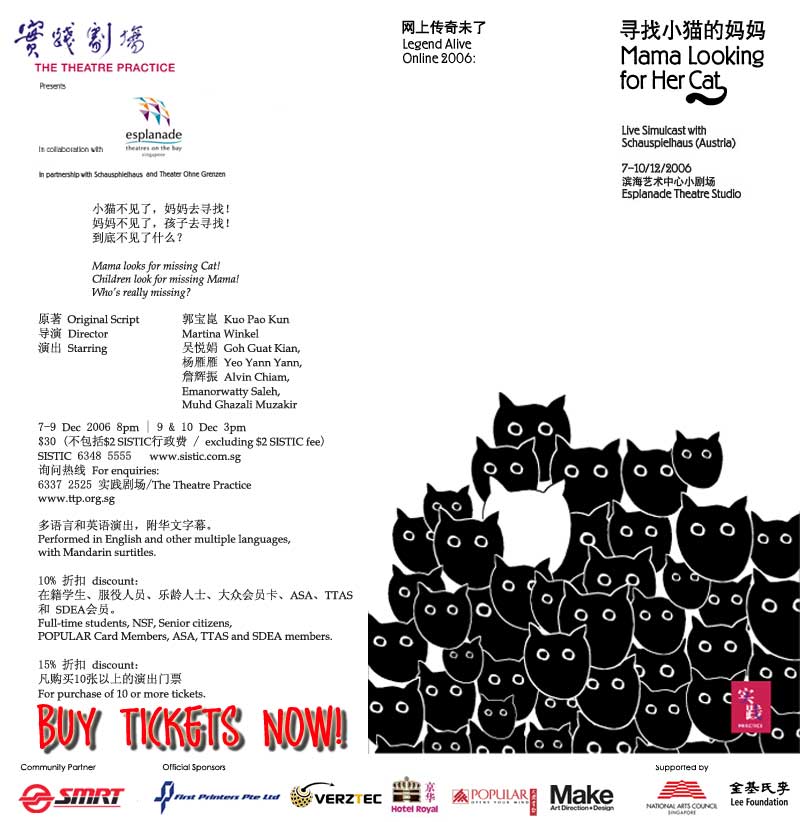
寻找小猫的妈妈

click on the poster to see a larger version, or visit www.ttp.org.sg for details of the performance.
Thursday, 5 October 2006
18年后的《雷雨》
看实践剧场上个星期演出的由吴熙导演的《雷雨》,总不免要一再想起18年前由北京来的夏淳导演的那个《雷雨》。两个版本最直接的联系,也最让人感到怅然的,是18年前饰演小儿子周冲的黄家强,这次饰演的却是老家长周朴园。如果从戏剧角色的年龄来看,18岁的周冲和65岁的周朴园相差48年;可是,黄家强的两次分别饰演,却只相差18年。戏剧时间和现实时间之间究竟是怎样的关系?理论上来说,戏剧时间往往是比现实时间过得更快,20年的恩恩怨怨可以在三个小时内叙述。黄家强在现实中过了18年,他在舞台上的角色却跨越了48年啊。这次饰演周冲的晓义,18年后会饰演什么角色?
我喜欢吴熙把“序幕”和“尾声”排出来。这是现实主义戏剧的一个特点--以 flash back 的方式叙述一个放大了的繁华光辉或充满激情的过往,而这个过往,则是 framed within 事过境迁的苍凉的回顾之中。可惜的是,饰演修女和小孩的演员都太弱了,使整个 frame 无法达到 framing 的效果。
我特别喜欢第四幕的舞台设计--将整个客厅的位置前后调转,让观众转换180度的方向看周家客厅里发生的事。第一、二幕,从房子内的角度看客厅里的事;第四幕,从房子外的角度看客厅里的事,结合各幕的情节,别有深意。--什么深意,我这里不说。因为我下个学期开的“中文剧场与表演”课,可能想讨论这个设计。--我的学生有在看我的 blog 的喔。
主要演员,虽然中国、台湾、新加坡、马来西亚都有,却几乎不会感觉南腔北调,让我感到有点意外。不过,却也让人深思。“经典”戏剧的舞台语言怎么那么“统一”啊?“经典”和“统一”之间的关系是什么?这是一个值得讨论的语言课题。--不多谈,留着下个学期的课再讨论。嘿嘿。
我喜欢吴熙把“序幕”和“尾声”排出来。这是现实主义戏剧的一个特点--以 flash back 的方式叙述一个放大了的繁华光辉或充满激情的过往,而这个过往,则是 framed within 事过境迁的苍凉的回顾之中。可惜的是,饰演修女和小孩的演员都太弱了,使整个 frame 无法达到 framing 的效果。
我特别喜欢第四幕的舞台设计--将整个客厅的位置前后调转,让观众转换180度的方向看周家客厅里发生的事。第一、二幕,从房子内的角度看客厅里的事;第四幕,从房子外的角度看客厅里的事,结合各幕的情节,别有深意。--什么深意,我这里不说。因为我下个学期开的“中文剧场与表演”课,可能想讨论这个设计。--我的学生有在看我的 blog 的喔。
主要演员,虽然中国、台湾、新加坡、马来西亚都有,却几乎不会感觉南腔北调,让我感到有点意外。不过,却也让人深思。“经典”戏剧的舞台语言怎么那么“统一”啊?“经典”和“统一”之间的关系是什么?这是一个值得讨论的语言课题。--不多谈,留着下个学期的课再讨论。嘿嘿。
Subscribe to:
Posts (Atom)